 Cedar-IBSi FinTech Labs
 Analyst Briefings
 Get in touch
 Back
Back
Ecosystems, Not Tools: Why Partner Strategy Now Defines Global FinTech Winners

By Delia Vulpe, Head of Ecosystem at SBS
Everyone talks about partnerships, but in global FinTech, the difference between a partner and a vendor is the difference between scalable growth and operational drag. True partnerships are not about filling technology gaps. They are about extending capability, accelerating execution, and sharing accountability for outcomes. As banks and FinTechs modernise across regions, the quality of their partner ecosystem increasingly determines how fast they can innovate, comply, and scale.
This is not a story about who has the most; it is about who has chosen the right ones.
The Role of Global Partners in Modern FinTech Ecosystems
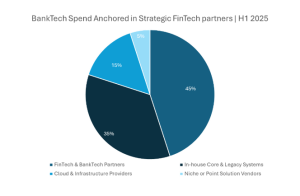
Modern financial institutions no longer build everything in-house. The stack has become too complex, regulatory expectations too dynamic, and customer demands too real-time. Core banking, payments, fraud, onboarding, lending, analytics, compliance, and cloud infrastructure are now interdependent layers, often sourced from different specialists.
Global partners add value in three concrete ways:
- Speed to market. Proven partners bring pre-built capabilities, reference architectures, and deployment playbooks.
- Risk transfer and expertise depth. Partners who operate across multiple geographies accumulate regulatory intelligence, stress-tested controls, and operational muscle that individual institutions struggle to replicate alone.
- Scalability with predictability. Partners that have scaled with tier-one banks, payment networks, or high-volume FinTechs understand peak loads, failure modes, and recovery design.
This is where SBS differentiates itself: combining global platform maturity, deep financial services specialisation, and cross-market execution capability to enable scalable, compliant growth.
 Why “Local Fit” Still Matters in a Global Partner Strategy
Global does not mean generic. One of the most common mistakes institutions make is assuming that a globally recognised partner will automatically succeed in every market.
Effective partners combine global product maturity with local execution depth. This includes regulatory localisation, on-the-ground support, and a clear understanding of regional operating models
Payment rails built for highly centralised, always-on environments can struggle in regions where settlement structures are fragmented, intermediaries play a critical role, and reliability varies by market.
The strongest partnerships resolve this by maintaining a single global architecture while enabling deep local configuration. They design the core once, but adapt rails, workflows, and controls to fit the realities of each market.
How to Select the Right FinTech Partners: What Actually Matters
Selecting partners is not a procurement exercise. It is a strategic decision with long-term consequences. The following criteria separate value-adding partners from expensive dependencies.
- Outcome alignment, not feature density
Focus on measurable outcomes such as cost reduction, fraud loss improvement, conversion uplift, or faster time to market, with clear ROI within 12–18 months. - Architectural compatibility
API maturity, modularity, cloud readiness, and data interoperability are non-negotiable, with modular architectures delivering 30–40% lower integration costs over five years.
- Regulatory and compliance credibility
Partners must demonstrate live compliance across multiple regulators, as penalties for data and compliance failures now routinely reach hundreds of millions of dollars. - Commercial sustainability
Many partnerships fail due to misaligned economics rather than technology. Pricing models must scale with volume and avoid structures where marginal transaction costs increase as usage grows. - Execution capability, not just vision
Evaluate implementation teams, local support, and post-go-live accountability, 50% of FinTech transformation delays are caused by execution issues, not product limitations.
 The Strategic Payoff of Getting Partnerships Right
When partnerships are chosen well, the benefits compound. Institutions innovate faster, enter new markets with confidence, and absorb regulatory change without panic. Internal teams focus on differentiation rather than plumbing. Customers experience reliability, not experiments. When partnerships are chosen poorly, the cost is silent but severe: stalled transformations, fragile systems, vendor lock-in, and strategic paralysis. Industry surveys consistently show that failed or delayed technology partnerships are among the top three reasons digital transformation programs miss their targets.
From Digital Ambition to Execution Reality
The next phase of FinTech growth will not be defined by who adopts the newest technology, but by who orchestrates the strongest partner networks. As financial services become more embedded and real-time, no institution can succeed alone. The winners will be those who treat partners not as suppliers, but as strategic co-builders of resilient, scalable and future-ready financial platforms. SBS operates precisely in this role, enabling institutions to orchestrate complex ecosystems with confidence.
Previous Article
IBSi News

October 06, 2026
Core Banking
Xero launches supplier payment analytics tool to support fair payments
Read MoreGet the IBSi FinTech Journal India Edition
- Insightful Financial Technology News Analysis
- Leadership Interviews from the Indian FinTech Ecosystem
- Expert Perspectives from the Executive Team
- Snapshots of Industry Deals, Events & Insights
- An India FinTech Case Study
- Monthly issues of the iconic global IBSi FinTech Journal
- Attend a webinar hosted by the magazine once during your subscription period
₹200 ₹99*/month
* Discounted Offer for a Limited Period on a 12-month Subscription
IBSi FinTech Journal
- Most trusted FinTech journal since 1991
- Digital monthly issue
- 60+ pages of research, analysis, interviews, opinions, and rankings
Other Related Blogs
September 29, 2026
Your next loan officer might not be a human, and that’s not necessarily a bad thing
Read MoreSeptember 15, 2026
Private credit has Matured. Operational Excellence is the Next Differentiator
Read MoreRelated Reports
US FinTech Market Landscape & Vendor Analysis 2026
Know More
Global Digital Banking Market Landscape & Vendor Analysis Q2 2026
Know More
Wealth Management & Private Banking Systems Report Q4 2025
Know More
US FinTech Market Landscape & Vendor Analysis 2026
Know More