 Cedar-IBSi FinTech Labs
 Analyst Briefings
 Get in touch
 Back
Back
Banks at the Crossroads of Payments Disruption: Strategic Choices for CXOs

By John Barber, Vice President and Head, Siva Subramaniam, Senior Industry Principal, Infosys Finacle
The global payments industry is entering a decisive phase. What was once a stable, utility-like function of banking is now one of the most contested arenas in financial services. According to McKinsey, payments generated $2.4 trillion in global revenue in 2023, with an additional $700 billion in growth expected by 2028. At the same time, J.P. Morgan estimates that digital platforms now drive $36 trillion in global payment volumes.
Yet scale alone does not guarantee control.
The payments landscape is fragmenting and accelerating beyond banks’ direct command. Real-time rails, tokenised money, embedded finance, and AI-driven commerce models are reshaping how value moves. Nearly 40% of global banking executives believe payments innovation will be led by Big Tech by 2030. That statistic captures the strategic tension facing the industry: banks must decide whether to remain processors or become orchestrators of programmable liquidity, compliance, and settlement infrastructure.
Tokenisation and Regulated Stablecoins: Rewiring the Settlement Layer
Tokenisation and regulated stablecoins are transitioning from experimentation to infrastructure. Stablecoin issuance has expanded significantly over the past few years, with daily transaction volumes now reaching tens of billions of dollars. Regulatory clarity in key jurisdictions, including the US, EU, UK, Hong Kong, and Japan, is reducing uncertainty and enabling institutional participation.
More importantly, tokenised deposits and regulated digital money are beginning to address real enterprise use cases. Programmable settlement, atomic delivery-versus-payment mechanisms, reduced float, and fewer intermediaries position tokenised money as an enterprise-grade settlement layer not merely a crypto asset class. B2B treasury management, supply chain finance, and intraday liquidity optimisation are emerging as early institutional applications.
For banks, the question is no longer whether tokenisation will matter but how to integrate it without destabilising existing infrastructure. Forward-looking institutions are treating token rails as modular extensions of settlement architecture: piloting defined corridors, designing custody and compliance frameworks, measuring improvements in settlement latency, reconciliation time, float reduction, and failed settlement rates.

Cross-Border Reinvention and the Rise of Agentic Commerce
Cross-border payments are undergoing structural redesign. Real-time payment systems, card-network corridors, regional clearing linkages, and token-based rails are reducing reliance on traditional correspondent banking chains.
The scale of real-time momentum is undeniable. Instant settlement is no longer an innovation; it is becoming baseline infrastructure. Simultaneously, a new force is emerging: agentic commerce. AI agents are beginning to initiate, authorise, and settle transactions autonomously across borders and platforms. Mastercard’s recently announced Agent Pay program, developed in collaboration with Microsoft and IBM, embeds tokenised, AI-initiated payments directly into conversational and enterprise AI environments. This signals a shift toward machine-driven transaction networks where payment initiation is automated, contextual, and embedded.
This evolution demands more than speed. It requires deterministic settlement logic, programmable compliance, rollback frameworks, and machine-grade APIs with formal service-level guarantees.
Banks that design multi-rail treasury and liquidity architectures, integrating SWIFT/ISO 20022, RTP systems, card schemes, and tokenised corridors, will shape the infrastructure layer for AI-driven commerce.
Consortium Networks and Private Corridors: Control Through Collaboration
Cross-border payments remain expensive and slow. According to World Bank data, remittance costs globally still average between 6% and 7%, and settlement times can extend from one to three days.
In response, banks are forming consortiums and closed user groups to create targeted settlement corridors. SWIFT has launched tokenisation pilots with more than 30 financial institutions to test interoperability across public and private ledgers. Meanwhile, initiatives such as Partior (backed by DBS, J.P. Morgan, and Temasek) and Fnality are building bank-led digital settlement networks for interbank payments and securities.
These private rails are not attempts to bypass global systems—they are strategies to optimise specific corridors, industries, and liquidity pools. Energy markets, trade corridors, and high-volume remittance routes are increasingly being served through ecosystem-driven models that reduce intermediaries and improve FX efficiency.
Participation in these networks is becoming a strategic decision about margin defence and corridor ownership. Banks must determine where to lead, where to partner, and where to integrate based on transaction volume, regulatory complexity, and ecosystem readiness.
The Multi-Network Reality: Beyond a Single Default Rail
For decades, cross-border payments defaulted to SWIFT-based correspondent networks. That model is evolving into a multi-network environment.
Card schemes are expanding cross-border B2B capabilities. Mastercard Move Commercial Payments enables near real-time international transfers outside traditional correspondent chains. Regional systems such as China’s CIPS, RTP linkages across Asia, and blockchain-enabled networks such as RippleNet are diversifying global settlement pathways.
Fragmentation does not imply instability. It signals redistribution of control.
The future of cross-border payments will not be defined by one universal rail, but by dynamic routing across interoperable networks—selected based on speed, cost, liquidity requirements, and regulatory context. Banks must build orchestration layers capable of intelligent routing across these alternatives.
Continuous Modernisation: The Answer for Next-Gen Payments
One-time transformation programs are no longer sufficient. Payments infrastructure is evolving simultaneously across regulation, digital assets, AI, interoperability mandates, and regional networks.
The strategic response is continuous modernisation through composable platforms.
Composable payment architectures built on modular components, API-first interoperability, and ISO 20022 data models allow banks to integrate new rails, introduce services rapidly, and isolate risk without destabilising core systems. They provide the flexibility to connect to tokenised networks, embedded finance ecosystems, agentic transaction layers, and real-time settlement systems in parallel.
In a world where payments are becoming embedded, automated, programmable, and globally interconnected, composability is not a technology upgrade. It is a competitive necessity.
IBSi News

Get the IBSi FinTech Journal India Edition
- Insightful Financial Technology News Analysis
- Leadership Interviews from the Indian FinTech Ecosystem
- Expert Perspectives from the Executive Team
- Snapshots of Industry Deals, Events & Insights
- An India FinTech Case Study
- Monthly issues of the iconic global IBSi FinTech Journal
- Attend a webinar hosted by the magazine once during your subscription period
₹200 ₹99*/month
* Discounted Offer for a Limited Period on a 12-month Subscription
IBSi FinTech Journal
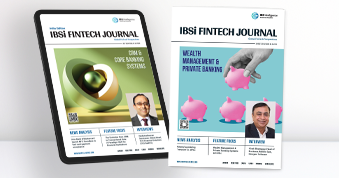
- Most trusted FinTech journal since 1991
- Digital monthly issue
- 60+ pages of research, analysis, interviews, opinions, and rankings
Other Related Blogs
October 06, 2026
Ecosystems, Not Tools: Why Partner Strategy Now Defines Global FinTech Winners
Read MoreSeptember 29, 2026
Your next loan officer might not be a human, and that’s not necessarily a bad thing
Read MoreRelated Reports
US FinTech Market Landscape & Vendor Analysis 2026
Know More
Global Digital Banking Market Landscape & Vendor Analysis Q2 2026
Know More
Wealth Management & Private Banking Systems Report Q4 2025
Know More
US FinTech Market Landscape & Vendor Analysis 2026
Know More