 Cedar-IBSi FinTech Labs
 Analyst Briefings
 Get in touch
 Back
Back
FinTech 2026: Why Credit Line on UPI Will Reshape the Entire Ecosystem

By Priyanka Kanwar, CEO & Co-Founder, Falcon
2025 was the year India’s payment rails quietly became credit rails. UPI stopped being just a way to pay; it became the default interface through which millions of customers now expect to access credit. And as we look to 2026, one thing is increasingly clear: Credit Line on UPI (CLOU) is on track to reshape the financial ecosystem in a way no previous credit product has. Credit on UPI and RuPay Credit Card on UPI, on the other hand, sit inside the rails where India’s most frequent payments already happen. They bring credit into moments where users were historically using only debit or cash, such as the kirana store, the pharmacy, the auto stand, the milk booth.
While CLOU is still early, the behavioural foundation around it is already strong. Credit Card on UPI has moved from novelty to hygiene. If a bank gives a customer a credit limit, that customer now assumes they can scan a QR and pay from that same limit. This behaviour is so entrenched that banks today are compelled to offer a RuPay add-on card under the same limit simply because users live inside QR flows. CLOU is tapping into that very same habit — a habit that will only deepen in 2026.
Early CLOU Signals: When Behaviour Meets Product-Market Fit
Banks that have started scaling CLOU, whether through TPAP partnerships or to their own customer base, are seeing the same pattern emerging: activation is seamless, usage is high-frequency, and repayment rates are strong. Some of the benefits of CLOU are— NPA rates under 2% for standard small-ticket credit usage, the product can go live within 8-12 weeks, making CLOU one of the fastest regulated credit products to launch, acquisition costs are nearly 1/5th of traditional credit cards, thanks to UPI-based discovery and daily transaction behaviour, not the episodic usage typical of credit cards.
This combination of frictionless onboarding, familiar payment behaviour, and responsible repayment is what gives CLOU its momentum. Early data is not just encouraging; it points to a product that will scale rapidly in 2026.
Small Finance Banks are leading the charge
Small Finance Banks (SFBs) have emerged as the earliest and most aggressive adopters of CLOU. Many of them haven’t launched credit cards yet, and CLOU provides an opportunity to reach their “right-to-win” customer segments — new-to-credit users, low-income households, and purpose-led use cases like two-wheeler financing.
Take Jana Small Finance Bank, a bank that has ambition to use scale CLOU with the goal of expanding access to short-tenure credit via UPI. Their experience reflects what many SFBs are discovering: CLOU aligns naturally with their customer profiles and growth ambitions.
The next wave will come from mid-sized banks — institutions with strong deposit franchises and large ETB bases. CLOU gives them a fast, compliant, and economically viable entry into credit at scale, with the opportunity to upsell customers into premium products over time, such as credit cards.
CLOU Is Driving a New Wave of Core Modernisation
The most interesting shift we’re seeing is architectural. CLOU is dynamic , has configurable interest rules, MCC-based controls, high-velocity authorisations, and multiple repayment pathways which makes it incompatible with rigid legacy systems. Banks today understand this more than ever before.
Some forward-looking institutions, like Karur Vysya Bank (KVB), have already migrated entirely to modern platforms to future-proof their credit business. Many of the country’s top banks are building parallel modern systems because they recognise that CLOU simply cannot be supported by legacy infrastructure, not from an innovation standpoint, and not from an economics standpoint. In essence, CLOU is accelerating the industry’s migration away from legacy.
Falcon’s Role: Becoming the Extended Credit Department for Banks
A remarkable shift underway is the way banks especially those outside the top five are now able to execute ambitious credit strategies because of specialised partners.
At Falcon, we often operate as an extended credit department for these institutions. CLOU is built on our CreditFX platform, which handles everything end-to-end from underwriting flows, UPI integration, configurable credit line parameters, billing and repayments, AI-driven collections and risk monitoring and portfolio insights to unlock cross-sell into credit cards and loans.This is what has allowed smaller and mid-sized banks to accelerate credit expansion without needing to build large in-house teams.
2026 Will Put India’s FinTech Infrastructure on the Global Map
The way UPI is going global due to NPCI’s efforts, India now has the chance to export not just payments but credit innovation. CLOU is a uniquely Indian idea: instant, regulated credit embedded inside the country’s most trusted payment rail. Very few markets have the digital public infrastructure to replicate this model today. 2026 will be the year India’s credit stack becomes a global reference point.
A New Credit Architecture for the Next Decade
CLOU is not just another lending product; it signals a fundamental shift in how India will experience credit in the coming decade. As user behaviour becomes unmistakably UPI-first, credit is moving to the rails where everyday financial life already happens. Banks
are modernising their stacks to support this shift, backed by AI-driven underwriting and collections that make small-ticket credit both scalable and safe. With SFBs and mid-sized banks leading the innovation curve and UPI’s global footprint expanding India is no longer just shaping the future of payments, but defining a new credit architecture for the world. This is the next chapter of India’s financial system faster, more inclusive, and built for the way people live and transact today.
If 2025 was the year UPI shaped credit behaviour, then 2026 will be the year CLOU reshapes the entire ecosystem.
IBSi News

Get the IBSi FinTech Journal India Edition
- Insightful Financial Technology News Analysis
- Leadership Interviews from the Indian FinTech Ecosystem
- Expert Perspectives from the Executive Team
- Snapshots of Industry Deals, Events & Insights
- An India FinTech Case Study
- Monthly issues of the iconic global IBSi FinTech Journal
- Attend a webinar hosted by the magazine once during your subscription period
₹200 ₹99*/month
* Discounted Offer for a Limited Period on a 12-month Subscription
IBSi FinTech Journal
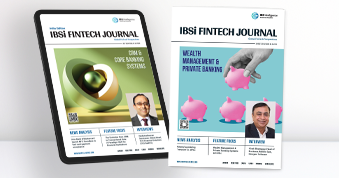
- Most trusted FinTech journal since 1991
- Digital monthly issue
- 60+ pages of research, analysis, interviews, opinions, and rankings
- Global coverage