
 Cedar-IBS Intelligence FinTech Labs
 Analyst Briefings
 Get in touch
Reinventing Retail Banking: From Digital Channels to AI-Native Growth
Banks have won the customer's login. The next contest is for the customer's wallet. Winning the wallet for banks means the chance to win the customers' savings, credit and investments, and with them the whole relationship.
This whitepaper shows how retail banks can turn everyday digital activity into deeper, more valuable relationships.
Access is solved. Ownership is not.
Most customers can now bank, pay, save and borrow on their phones. But access does not decide who owns the relationship.
A customer may get their salary into one bank, spend through a wallet, save with another provider and borrow from a digital lender. They still have a bank account. The bank no longer owns the relationship.
The growth question has changed: not "can customers bank digitally?" but "can the bank turn each interaction into a deeper financial relationship?"
Shallow engagement, new rivals, squeezed margins, slow systems: why being digital no longer wins the customer
Reach is not relationship
Downloads and sign-ups say little about who owns the customer. Usage and balances do.
Competing on relationships, not products
Non-banks now offer savings, credit and investments too. Migration of customer wallets is the largest risk banks face.
Channel-led growth has hit its limit
Digital raised customer expectations. So, the cost of serving each one must reduce.
Legacy technology sets a speed ceiling
Banks spot change faster than their systems can respond.
Winning banks will act on all four.
Five moves that turn digital activity into deeper, more valuable relationships
- Measure growth with two metrics, not one. Monthly Active Users (MAU) show whether customers come back. Assets Under Management (AUM) show whether they trust the bank with their money. AI-native growth moves both.
- Speed of response decides value. A customer signal that takes weeks to become a campaign is stale. Banks must close the loop from behaviour to decision to action.
- Three shifts make the model work. Products move from standard design to personalised generation. Decisions move from after-the-event to pre-emptive. Engagement moves from mass outreach to precise, in-context offers.
- Automate in proportion to risk. Low-risk decisions can run straight through. Higher-risk decisions get a machine recommendation and human approval. Governance gets stronger, not weaker.
- Modernise step by step, not all at once. A full core replacement is not the only path. Banks can build a new operating layer around their busiest growth journeys and keep legacy systems that still do their job.
When engagement and assets grow together, growth starts to compound
More activity creates more customer signals. Better signals lead to sharper offers. Sharper offers deepen balances and product use. A deeper relationship gives customers more reasons to stay active. The loop then repeats.
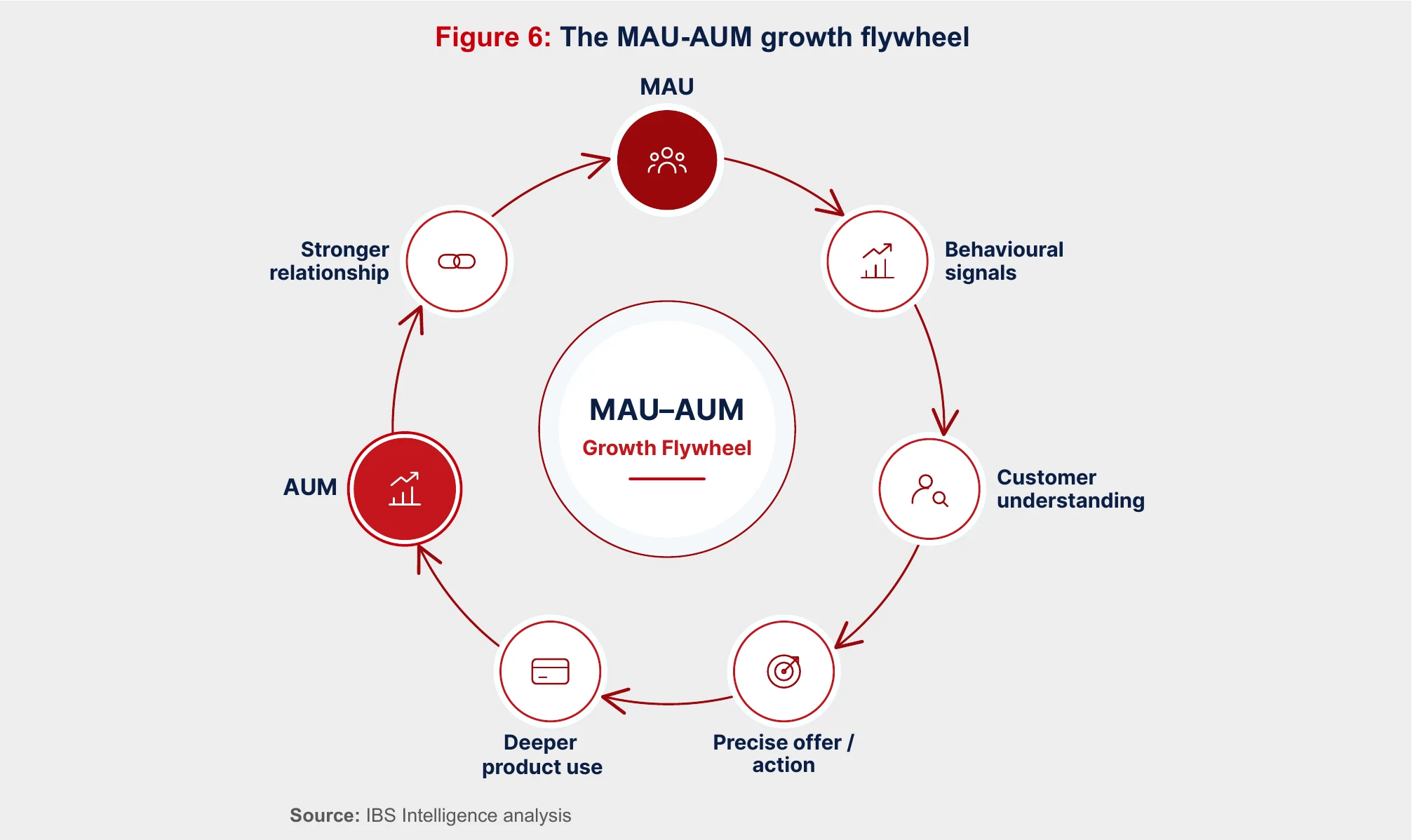
"This flywheel only works when the bank can close the loop from behaviour to decision to fulfilment."
Four questions every retail bank leader should ask
- Are more customers coming back every month?
- Are they placing a larger share of their deposits, payments, credit and savings with us?
- Can we change propositions faster without adding operational risk?
- Can we make sharper decisions without losing explainability or control?