 Cedar-IBSi FinTech Labs
 Analyst Briefings
 Get in touch
 Back
Back
From Influence to Infrastructure in Bank Software Decisions

By Delia Vulpe, Head of Ecosystem at SBS
Everyone talks about influence. Analyst opinions, peer recommendations, industry rankings, and thought leaders now sit prominently in bank buying journeys. Yet in enterprise banking software, influence rarely converts on its own. It establishes credibility and narrows options, but purchasing decisions are ultimately driven by internal evaluation and risk approval.
Bank technology buying has become slower, more risk-weighted, and more centralised. Consequently, external influences are exerting a growing impact on the initial stages of consideration, even as conventional enterprise sales processes continue to dictate the ultimate decision-making and contract value.
Where Influencers Actually Influence Bank Buying Decisions
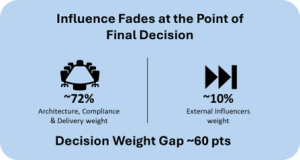
Influencers exert their most significant influence prior to the formal procurement process. Across global banking technology purchases (2024–2025), 60–65% of banks rely on analyst reports, peer references, or advisory input to form initial vendor shortlists. However, only 20–25% allow external or influencer input to materially affect final vendor selection. In practice, influencers shape who gets evaluated, not who gets bought. They add value in three places:
- Shape how banks interpret themes, influencing early vendor entry
- Compress shortlists: Reduce 20–30 vendors to 5–7 before RFP issuance
- Provide risk cover: Enable CIOs to justify change to boards and committees
 Where Influencers Stop Mattering
Once banks move into RFP, proof-of-concept, and commercial negotiation stages, the weight of influence drops sharply.
At this stage, banks prioritise:
- Integration complexity
- Regulatory compliance and auditability
- Implementation timelines
- Total cost of ownership over 5–7 years
No analyst ranking compensates for failed integration tests.
Traditional Enterprise Sales: Still Where Deals Are Won
Despite increased market noise, over 80% of global banking software contract value is still closed through traditional enterprise sales motions.
This includes:
- Multi-stakeholder engagement across IT, risk, compliance, and procurement
- Formal, structured vendor evaluation cycles governed by internal procurement and governance frameworks
- Sandbox testing and pilots
- Security, data residency, and regulatory reviews
- Multi-year pricing and SLA negotiations
Banks buy software as long-term operating dependencies, not as products. This structurally favours vendors with strong sales engineering, delivery teams, and post-go-live accountability. This is where SBS Software positions itself, delivering structured enterprise engagement, regulatory-aligned architecture, and long-term operational accountability across banking technology programs. Influence may get attention. Enterprise sales convert revenue.
How Vendors Should Respond to the Influence Reality
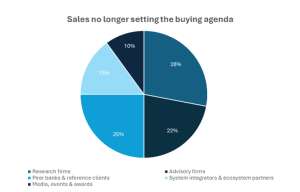 Understanding influence is only useful if it changes behavior. For banking technology vendors, this means designing go-to-market strategies that reflect how decisions are actually made, not how marketing teams wish they were made.
Influence should be treated as an entry mechanism, not a closing strategy. Analyst engagement, advisory connections, and ecosystem awareness need to be carefully managed to secure a place in initial discussions and on vendor shortlists, but once a vendor is in the running, the focus must shift dramatically to demonstrating the ability to deliver.
This means demonstrating a deep understanding of the architecture, presenting a solid regulatory strategy, and providing concrete plans for implementation that can withstand the close examination of risk and compliance teams. SBS Software embodies this approach, prioritising architectural expertise, compliance preparedness, and disciplined execution over mere market presence.
Vendors that don’t adapt to this reality frequently find themselves visible but ultimately not chosen. Those that succeed understand that influence creates permission to engage, while execution earns permission to proceed.
Selling to Banks in a Risk-Weighted World
Bank software procurement is becoming more conservative as regulation tightens and technology underpins systemic stability. Banks are concentrating spend with fewer vendors and demanding higher accountability.
Winning in this environment requires patience and precision. Vendors must engage multiple stakeholders over long cycles, address regulatory and operational risk in parallel, and demonstrate resilience across the full product lifecycle. External influence may accelerate initial trust, but credibility is sustained through delivery discipline, governance, and post-implementation performance.
The vendors that succeed are not the most visible, but the most aligned. They understand the bank’s risk posture, fit its operating model, and reduce complexity rather than introduce it. Influence opens the door; reliability determines who stays.
IBSi News

Get the IBSi FinTech Journal India Edition
- Insightful Financial Technology News Analysis
- Leadership Interviews from the Indian FinTech Ecosystem
- Expert Perspectives from the Executive Team
- Snapshots of Industry Deals, Events & Insights
- An India FinTech Case Study
- Monthly issues of the iconic global IBSi FinTech Journal
- Attend a webinar hosted by the magazine once during your subscription period
₹200 ₹99*/month
* Discounted Offer for a Limited Period on a 12-month Subscription
IBSi FinTech Journal
- Most trusted FinTech journal since 1991
- Digital monthly issue
- 60+ pages of research, analysis, interviews, opinions, and rankings
Other Related Blogs
September 15, 2026
Private credit has Matured. Operational Excellence is the Next Differentiator
Read MoreRelated Reports
US FinTech Market Landscape & Vendor Analysis 2026
Know More
Global Digital Banking Market Landscape & Vendor Analysis Q2 2026
Know More
Wealth Management & Private Banking Systems Report Q4 2025
Know More
US FinTech Market Landscape & Vendor Analysis 2026
Know More